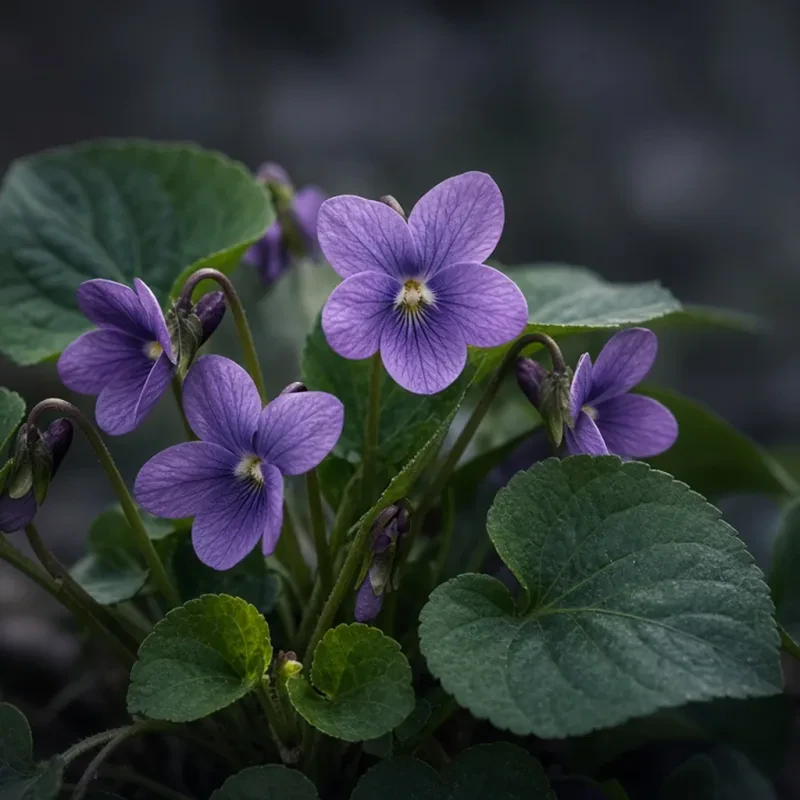


- Latin name
- Viola odorata
- Family
- Violet family (Violaceae)
- Origin
- France, Egypt (leaves)
- Parts used
- leaves (material is hardly ever obtained from the flowers)
- Raw materials
- violet leaf absolute; the flower's scent is recreated with ionones
- Extraction
- solvent extraction (leaves)
- Olfactory group
- powdery floral
- Position in the pyramid
- heart
- Synthetic substitutes
- alpha- and beta-ionones, methyl ionones
The violet is a small woodland flower with a big role in the history of perfumery. Natural extract of violet flowers is too expensive, so almost all the violet scent in perfume is created by synthetic molecules — ionones, discovered in the 1890s. From the plant itself the leaves are used.
How it smells: the flower is powdery, sweetish, slightly berry-like and “cosmetic”, like an old powder compact. The leaves are something else entirely: green and watery, with shades of cucumber and freshly cut grass. Together they give both tenderness and freshness.
The discovery of ionones made violet fashionable at the turn of the twentieth century: Parma violets became a symbol of the era, and violet perfumes, powders and sweets appeared. The same ionones help recreate iris today.
What it pairs with: with iris — powdery classics, with rose — a tender vintage bouquet, with raspberry and blackberry — berry violet, with leaves and cucumber — fresh green violet, with suede and leather — an elegant “glove” composition.
Good to know: beta-ionone briefly “switches off” the receptors that detect it — so the scent of violet seems to vanish and come back. And some people can barely smell ionone at all.
Fragrances with Violet