
- Latin name
- Abies alba, Abies sibirica
- Family
- Pine family (Pinaceae)
- Origin
- Central Europe (the Alps, the Carpathians), Siberia
- Parts used
- needles and young twigs
- Raw materials
- needle essential oil
- Extraction
- steam distillation
- Olfactory group
- aromatic (coniferous)
- Position in the pyramid
- top and heart
- Synthetic substitutes
- bornyl acetate, pinenes
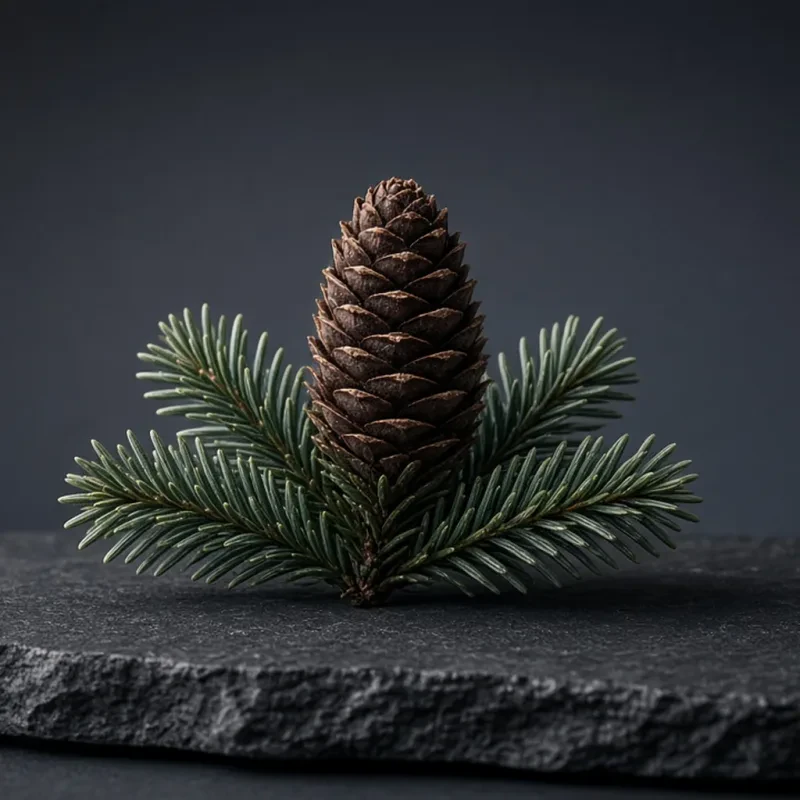
Fir is a tall, slender conifer with soft flat needles that grows in the mountains of Europe, including the Carpathians. The oil is obtained by distilling the needles and young twigs.
How it smells: fresh, resinous and softly coniferous, with a balsamic and faintly lemony shade. Fir sounds softer and sweeter than pine — like a fresh Christmas tree in a warm room.
The characteristic festive smell of fir comes from bornyl acetate — the same molecule you smell in a pine forest, but in fir its combination with balsamic notes makes the scent cosier and more festive.
What it pairs with: with frankincense and myrrh — resinous festive compositions, with vanilla and amber — a warm winter conifer, with lavender — fresh fougères, with citrus — a lively “mountain” opening, with leather and tobacco — cosy “hunting lodge” fragrances.
Good to know: in many countries fir rather than spruce is chosen as the Christmas tree: its needles are softer and stay on longer.